Showing posts sorted by relevance for query java. Sort by date Show all posts

Friday, November 11, 2011

Settlers of Catan Rules in Open Source Games (aka Clones, Remakes, Implementations)

Settlers of Catan is a popular board game. In today's terms it can be described as very 'social' thanks to its trade mechanic, which can lead to exploitation, corruption, deception... all that fun stuff.

There are a few open source implementations of the game rules, some of which I mentioned years ago and with two of them being updated recently, I decided to revisit them.

First, a few fun facts in comparable table form, further below you'll find screenshots, impressions and feature lists. Enjoy! If you're looking for somebody to play against, why not try the #freegamer IRC channel? :)

Thanks for hiponboy's (of SumWars fame) help at testing games and collecting data!

GamePlatformActivity© Infringement™ InfringementCompilable?
Pioneers
(pio)
C, GTK+activeHex-tiles look suspiciousNone foundYes (./configure && make)
Java Settlers of Catan
(jsettlers2)
JavaactiveYes ("Gorillaz" character portrait file in resources)Yes ("Settlers of Catan")Yes (ant)
Cities3DC/C++, openGL6 months agoNone foundNone foundNo (./configure error)
Solitaire Settlers of Catan
(solitairecatan)
Java3 years agoYes (original Catan card images)Yes ("Settlers of Catan")No (ant error)
jCatanoJava5 years agoNone foundPossibly ("Catan")Yes (ant)
GL CatanC/C++, openGL5 years agoYes (original Catan card images)Possibly ("Catan")No (source not found)
Java Settlers of Catan
(javasettlers)
Java6 years agoNone foundYes ("Settlers of Catan")No (instructions missing)
Nettlers of Catan
(nettlers)
C/C++7 years agoNone foundPossibly ("_ettlers of Catan")No (not ported to Linux)


In the table I pointed out copyright and trademark infringement, which according to this article created problems for SoC clones in the past.

I encourage project maintainers to check whether all assets are openly licensed, credited and legal and distance themselves from the Settlers of Catan trademark to avoid confusion.

Pioneers


Pioneers is feature-loaded and is configurable in content (maps), look (theme) and gameplay (rules).

Features: Various boards, Seafarers mode available, network multiplayer or single-player, one AI level, map editor, complex trade (not sure if it's possible to trade multiple vs multiple resources though), few custom rules, themes


Java Settlers of Catan (JSettlers2)


JSettlers2 nice to play with complex trade, although offers can be confusing and widgets can't be resized individually.

Another drawback is the apparently forced slowness of the AI. On the other hand the AI sometimes offers trade, which makes it stand out from the trade-passive AI of the other games.

Features: Board for 4/6 players, network multiplayer or single-player, one AI level, complex trade, few custom rules

My suggestion for a hopefully non-infringing name change: "Builders of Javatan"

By the way, I was inspired to create a little tile set for JSettlers2.


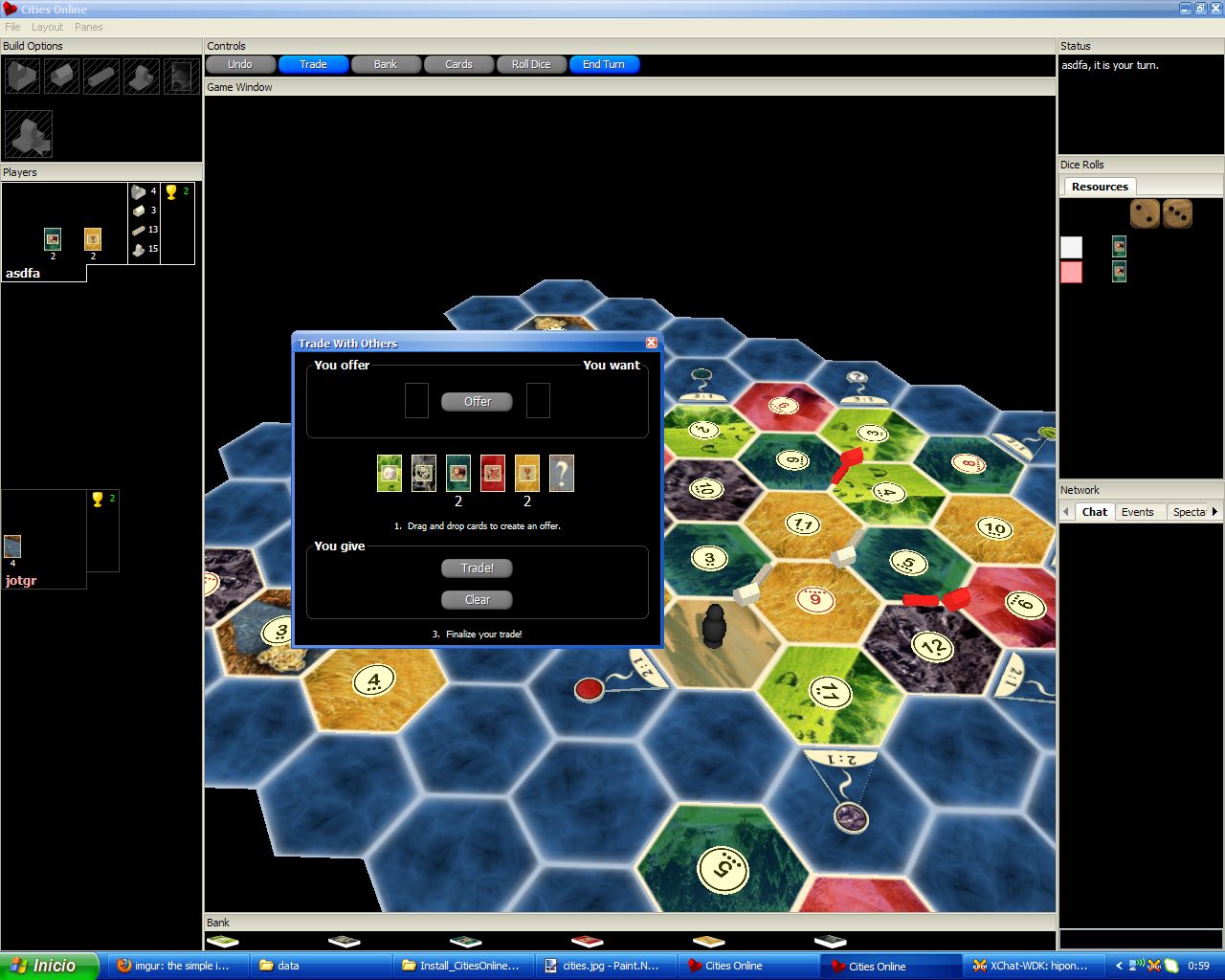
Cities3D


Cities3D looks great and feels great but needs a developer/maintainer.

Unfortunately FMOD is used for sound, which renders the game non-free.

Features: Various boards, Seafarers mode available, network multiplayer only, complex trade, polished UI, sounds


Solitaire Settlers of Catan


Solitaire Settlers of Catan has a nice look and a clear trade interface (although unfortunately only simple trade is possible).

Features: Board for 4/6 players, single-player only, different AI levels, simple trade, additional Volcano scenario

jCatano


jCatano has a non-intuitive interface and is a bit of a pain to play with for example no resource icons and impossible action buttons not being grayed out.

Features: Board for 4 players only, network multiplayer only, no harbors, no trade between players, unpolished UI

GL Catan


As long as source code is missing, GL Catan can be considered proprietary software.

Features: Custom board size, single-player only, different AI levels, savegames, map editor, no trade with AI, points to win can be set


Java Settlers of Catan (javasettlers)


Javasettlers is not playable.

Features: Javasettlers is a techdemo of board rendering and building placement.


Nettlers of Catan (nettlers)


Nettlers' advantage is its shortcut-driven interface and minimal UI.

Features: Custom board size, Seafarers mode only, multi-player only, complex trade, shortcut-driven interface

Note about features: "complex trade" means that "I will trade 2 wool and 1 wood against 1 iron" is possible with other players, "simple trade" means only "1 resource for 1" resource trade is possible.

Tuesday, July 17, 2007

Last Remaining Air Carrier

Last Remaining


Last Remaining is a 3D FPS RPG in the same vein as Deus Ex. The idea is to have an engrossing storyline where the player must take whatever action is necessary to get to the bottom of the mystery. The game is written in Java with JMonkeyEngine and first version was uploaded yesterday. Intriguing and definitely one to watch. :-)


The author is the same guy behind Passenger and Nuclear Graveyard, and has a devblog on his various game programming endeavours.


A previous release of Nuclear Graveyard had managed to become corrupted when uploaded, a fact which - much to the author's dismay - nobody reported for nearly 2 months despite over 100 downloads. Anyway, if you were one of those people who downloaded the game and (benefit of the doubt) was unable to get it working then now would be a good time to try again!


He is also moving Passenger from JOGL to jMonkeyEngine (which uses JOGL) which should make subsequent development of the game easier. Anybody who things Java is slow and rubbish for games may want to check out the jME showcase page.


Air Carrier


It turns out that at least one of the games on that showcase page is open source! Air Carrier looks like a splendid 3D aerial combat game. It aims to support single and multiplayer, with gameplay based around plane to plane dogfighting, and strategic use of airborne carriers.


Another notable open source project using jME is Java Classic RPG - the development of which is continuing at a nice pace.


All of these games mentioned today should support all major operating systems (at least Lin, Mac, Win plus anything else supported by JOGL) as they are written in Java - and Java is portable, right? ;-)


There is another good article over at Liberty Gaming that discusses stratagies for expanding Free gaming. He mentions Project Open which I need to really follow through on. Also I hope FG and the FG forums somewhat contribute towards making open source games more accessible, that's the intention anyhow.


I did have something else to mention but I'll save it for tomorrow.

Monday, March 10, 2008

Wesnoth Battling Onwards


Battle for Wesnoth


Well the big release of the weekend is Battle for Wesnoth 1.4 (changelog). Not too much to say about this game that hasn't been said hundreds of times before. It's simply the best open source game project going. Hundreds of contributors, graphics rivalling contemporary commercial 2D games. Over version 1.2, Battle for Wesnoth 1.4 brings 7 new campaigns, major UI improvements, major multiplayer improvements, many improved graphics (the portraits are stunning) and many bug and balance fixes.


Wesnoth is so popular that the response to this release seems to have overwhelmed parts of their website. The wiki and forums are unable to cope.


I'm wondering where they will draw the line with this project though. The main developer has since moved on to SilverTreeRPG. Obviously they could keep adding campaigns, refining the graphics etc, but surely at some point you want to say "this is it, this is the final v1 of Wesnoth" and look at making v2 which is a significantly different game (be it improved or different storyline or whatever). They surely just can't keep on evolving this version because then, well, it seems to be a bit of a waste of resources that could be used to create a different version. Once a game is complete, development is of diminishing returns. Sure, you can make it a bit shinier, but it's of much less value to the game playing community who [I think] would rather see major strides made on a new game rather than the same game have relatively small improvements.


OpenFracas 0.4 (currently just for Linux and Windows), "a free, open-source game that is similar to Risk." There's more gameplay features than in standard Risk, and it's also well done, so check it out if you like that kind of strategy game.


SuperTuxKart 0.4 is now up for download. No screenshots of 0.4 on the website, although it looks the same as 0.3 for the most part.


Space Exploration v5 - a fun little 2D space exploration and trading game. This version greatly enhances the UI, but I think the Java detractors will love this version because it's very very slow. I suspect the author isn't too experienced on Java graphics programming and as he learns more it will speed up greatly. Anybody who believes Java is slow should try out the rather spiffilicous JCRPG which not only looks beautiful but is very fast too. A bit of perseverance and Java "force" is all that's needed.

Thursday, June 01, 2006

Deadly Soccer in a Warzone

A rather topical title has just been released, Slam Soccer 2006 (a.k.a. Bolzplatz 2006), a 3D soccer game with cartoon-style players. It requires Java 1.5 but don't let that put you off. With some half-decent hardware, it looks like fun. It did not perform well enough on my machine to be playable - however I blame my GeForce2, so do not let the Java tag put you off. Quite a few decent games are appearing in Java recently. There's even a Java port of Quake 2 - Jake2.


Warzone 2100


The not-so-well-known Free game Warzone 2100 continues to be updated. Importantly, for me, it looks good and runs good on older hardware.


It is a 3D RTS game that was originally a commercial title. One of the contributors is an Ubuntu user and, over in the forums, gave an overview of the state of Warzone. It looks like it's coming together nicely. Even though a bit of the original game content still isn't working in the Free version (notably the cut-scenes), it still feels like a very complete game and is definitely worth trying. There is a very dedicated community and such dedication only forms behind decent games.


DROD


Thanks to Evil Mr Henry for pointing out where to find the freeware version of DROD v1. It's DROD v2 that's not freeware, although the DROD engine is released under the MPL.


A bit of a short one today; I must do some work before I turn into a blog-junkie and lose everything dear to me.


Edit: Uploaded the screenshots to blogger to stop the berlios.de pestering for https confirmation. Apologies for any inconvenience.

Sunday, April 26, 2009

Quick & Dirty FLOSS Game Updates

== Insert introductory text here ==


Strategy games


Civitas city

Civitas is a project of a colaborative educational game, where children from schools can cooperate in a network for the construction of cities.

This sounds/looks like a multiplayer OpenCity. Civitas is a GPLed project written in Java.


Thumbs up to kid/education-related game projects whose creators are brave enough to use standard free licenses!


Clippers

Clippers is a board game designed by Alan R Moon that is an abstract island connection game based on clipper ships and the south pacific. This computer version is written in Java 1.5 and includes AI players.

Just like Civitas, I wasn't able to give it a spin. Sorry, Java issues. :(


The Spring Engine has a nice new homepage and a pleasantly clear list of games. (This is probably very old news but kind of new to me.) I was told that Kernel Panic is a 100% open source game for Spring, but unfortunately I am either too stupid or too lazy to make it work. :|


Role-playing games


FreedroidRPG 0.12.1 has been released [download]. The main game map has been re-organized to make more plot-sense. It does, but too many gameplay-useless rooms full of stasis chambers have been added. To my feel, the game is now a lot harder too. However, the controls feel slightly better compared to the last time I tried it. Unfortunately I experienced annoying laggy map-loading and a few crashes from playing too many sounds at once (might have to do with my sofware mixer though). Check out the full changelog for more details.


Rigged FreedroidRPG armor

I noticed that FreedroidRPG's image sources (.blend and .svg files) have been uploaded. an unsorted heap of everything visual that is used in the game [archive tree]. I must say that I like the graphics much better in high resolution. 3D game developers eying this pack will be glad to hear that everything that needs rigging is rigged. For 2D game devs, there is a rendering guide.


Cheese Boys [remember?] is still in development - and still looking for artist help... though maybe someone to scout OpenGameArt would even be enough?..


Ardentryst is being constantly developed - the 1.7 release was added three weeks ago.


Eating daggers in Radakan

Radakan 0.0.1, which can be currently described as "young Qt GUI-driven text RPG", was released. Future plans include graphical clients and such. Creating a system to allow writing the story/gameplay before starting work on a graphical engine is a playing-it-safe decision. IMHO a good idea.


The WorldForge client Ember now has real-time shadows [announcement].


By the way, WorldForge is in the Google Summer of Code 2009. [GSOC page] as are some other game or gamedev-related projects, as seen in this list.


Game makers/tools


Dungeon Mapper

Dungeon Mapper is yet another tile map editor.


Mokoi Gaming 0.4 was released. It now supports OSX and contains a Tetris variant [changelog].


Development on Opensource Game Studio has started. Features: 3D, Qt, Lua. It contains a small glxgears-like demo [video]. Nothing to see here yet. :)


The rest


The two-day game programming competition Ludum Dare #14 has ended a while ago. Unfortunately nobody except arcticum's and Flood of Air's authors cared to release their game as open source software (or I couldn't find them).


Armagetron Advanced 0.2.8.3_rc2 [download] fixes color filters and crashes. [changelog].

Sunday, June 15, 2008

Hex Tower Defence and Java vector tools

HexTD close view
Hex Tower Defence is a Java-powered tower defense game inspired by the unfree, flash-based VectorTD.


You can play it inside the browser or grab hold of the code and install/compile it with the help of these instructions.


Gazelle desktop
HexTD uses the SVG Salamander Java vector library. It's author is Mark McKay, who is also working on an animation suite, which supports Scalable Vector Graphics: Gazelle.
Gazelle is a movie editor that makes it easy for you to create short keyframed animations on your computer.

There are some tutorial videos available. I look forward to playing around with Gazelle, as I'm very interested in using SVGs to create (animated) game media or to even use them directly in games.


HexTD gameplay (likely to be found boring ;) - also there's no sound by default)

Thursday, September 13, 2012

BartK's Personal Notes about the Liberated Pixel Cup

While we're waiting for the Liberated Pixel Cup contest results, I thought I'd take some time and post some personal thoughts about the contest in general, and what we might do better if we decide to run it again next year.  First, a disclaimer:  While several different organizations are taking part in LPC, the thoughts and opinions stated here are entirely my own, and do not necessarily reflect the opinions of the FSF, the Creative Commons, the Mozilla Foundation, or even OpenGameArt.org.  I am one of the people involved in running the Liberated Pixel Cup, but this blog post is not an official statement.  It's just my own ramblings. :)

First things first.  LPC was, in my opinion, an amazing success.  Since we're still in the judging process, I can't give my opinions on specific entries, but I will say that we have some really amazing ones in my opinion, and if you haven't already checked them out, I'd recommend that you do so.  One of our contestants has put together a large page of game reviews, so that's a good place to start if you're curious.

The Liberated Pixel Cup has always, in my opinion, been about the advancement of free and open source software, so one of the decisions we made very early on in the planning process was that we would require all entries to work on a system that is libre from the ground up.  That is, not only should the entries themselves be free software, they shouldn't require that any part of the system running them be closed-source or otherwise proprietary.  We caught a fair amount of flak for this decision, and I can't say I was particularly surprised, since a lot of people really love proprietary frameworks and libraries such as XNA, Flash, and others.  It's understandably frustrating if your system of choice is specifically disallowed, but think of it this way:  If someone have a Flash games competition (and there are plenty of these), people don't take offense because they aren't allowed to enter non-flash games.  It's not about the relative merits of various frameworks -- LPC is just a contest for free and open source games.  I'm pleased to say that I've spoken with at least one person who got their first experience developing games on a free platform, and has been very happy with it thus far.  I'm hoping there are others who feel the same way.  At any rate, while this decision didn't go over well with some people, it's not something that I would change in retrospect, and I can say with a fair amount of confidence that any future instance of LPC will have the same requirement.

We also got a number of complaints that the contest itself was too short.  This is something that kind of surprised me, since most game coding contests (Ludum Dare, Bacon Game Jam, etc) are a weekend or a week long at most.  It has been suggested on several occasions that we make the coding contest in particular last longer.  This is an idea that I'm personally willing to entertain, but we'll probably have to do some sort of informal survey to really get a feel for how long people in general feel the competition should be.  Even though several people suggested it, it's entirely possible that a majority of participants were satisfied with the length of the contest, so we'll have to look at some real numbers before we make any decisions based on this.  (One thing we'll almost certainly do is provide a "break" of a week or two between the art and code phases of any later contests.)

All that aside, far and away the biggest problem we had with LPC was what to do about all of the different operating systems and environments people might develop their game in.  There are two big things we had to take into consideration.
  • People want to be free to choose the environment they're developing their game on.
  • People want to be confident that their game will compile and run.
Taken together:
  • People want us to standardize on the system they personally like.
This is, of course, impossible, so we were left in the difficult position of having to give people advice for writing programs that will be easy to compile and run in multiple environment, but without pushing specific operating systems or frameworks.  This caused a lot of consternation on the part of the code entrants (and also the judges -- I'll address that further down), but as far as I can tell, there isn't a great solution.  We either standardize on a certain system with certain libraries and exclude a large number of potential participants, or ask people to write their code carefully so that the judges will be able to compile it.  I don't personally regret doing it this way, and hopefully some of the specific things we learned this time around (about common problems, etc), we can pass on to people the next time we do LPC (* there are currently no official plans to run LPC again, but I'd like to see it happen, and we'll talk about that once the results are announced).

When all was said and done, we ended up with about 50 code entries.  First, a shout out to the HTML5 folks -- your stuff just worked.  Also, I have to come out and say that I've never been a big fan of Java; it's always felt really clunky to me.  LPC made me reevaluate my position on Java games.   Given a set of entries that were built in different environments, it was an immense relief when I decompressed a game archive and found a bunch of .jar files, because I knew instantly that it would just work.  So, Java folks, a shout out to you too.

The remainder of the entries were written in other languages, mostly C and C++.  Some of them compiled very easily (these tended to be the ones based on established engines and frameworks, such as FLARE), others took a few tweaks, and there are a couple I still haven't managed to compile at all.  Which brings us to judging.

Judging has been slow.  Since this is the first time we've done this, we had no idea the magnitude of the response we'd get.  This is to some extent due to several perfectly legitimate desires that work in conflict:
  • People want to be able to write their games in the environments they prefer (see above).
  • People would like the judges to take time to fairly evaluate their submissions, rather than just giving them a zero the first time they run into trouble.
  • People would like the contest results to be announced quickly.
In short: pick any two.  As it stands, the judges (myself included) are doing our best to be fair and thorough, but the downside is that the entries require a lot of attention, and, given that we have jobs and families, we can't put a full 40+ hours a week into judging, which means the results are slow.  Not only that, personal lives have a way of changing at a moment's notice, so it's very difficult to even guess how long the judging process will take.  While I'm hesitant to give any sort of estimate right now (due to the fact that mostly I'd be pulling a number out of you-know-where, plus my three previous estimates have come and gone), what I can say is that in future years, we'll likely base our estimate of when the results will be announced on the amount of time that it takes us this year.  Hopefully, if we can offer a set of suggestions to make later contest entries easier to compile (and perhaps as a result of the extra suggestions, be a bit harsher if we're unable to do so), we can make the judging process more efficient.

Anyway, that's about it -- an inside view of my personal thoughts on the Liberated Pixel Cup.  I'd be happy to answer any questions that I can, but before I do so, two things bear repeating:
  • These are my thoughts alone, and they do not represent the official thoughts of LPC or any of the organizations involved.
  • We're working on judging, and while I'm happy to provide progress updates, I can't give an estimate on when judging will be completed because I simply have no way of knowing.  We will keep at it and get them done, but it could be two weeks from now, and it could be December.
Peace,

Bart K
http://opengameart.org


Provide feedback:

Due to SPAM issues we have disabled public commenting here.

But feel free to join our forums or easily chat via IRC with us.